Working Women’s Rally Calls for Peace, Social Justice
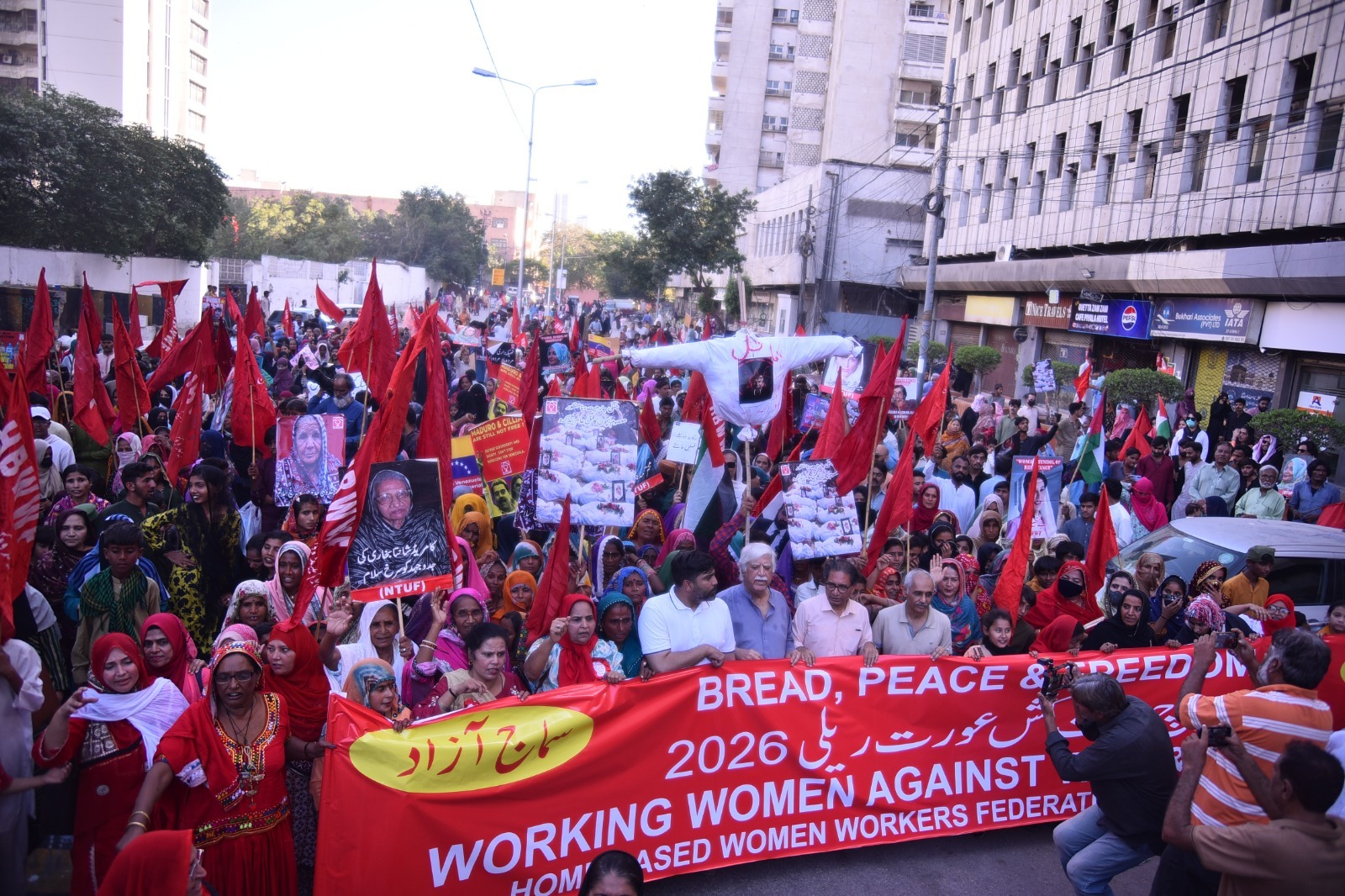
Karachi (Press Release), March 8, 2026: Speakers at the “Mehnatkash Aurat Rally,” organized by the Home-Based Women Workers Federation Pakistan (HBWWF) on International Women’s Day, warned that growing militarization, imperialist conflicts and military occupations were pushing the world toward a dangerous crisis, with women and children among the worst affected.
The rally, led by HBWWF General Secretary Zehra Khan, marched from the Arts Council of Pakistan to the Karachi Press Club under the slogan “Working Women: Against War and Oppression.” Thousands of working women, including peasants and home-based workers, participated, carrying placards, red flags and posters of prominent women who played key roles in democratic and labour struggles.
Addressing the gathering, Zehra Khan said the day was being observed amid a turbulent global environment marked by wars and humanitarian crises. She said conflicts in regions such as the Gaza Strip, Lebanon and Yemen had caused immense human suffering, while rising geopolitical tensions were threatening peace in many parts of the world.
Asad Iqbal Butt of the Human Rights Commission of Pakistan criticized what he described as policy contradictions in Pakistan, noting that groups once supported by the state were now labelled threats, while dissenting voices were often branded as traitors.
Speaking on the occasion, Nasir Mansoor of the National Trade Union Federation Pakistan said global military spending had reached about $2.7 trillion in 2024, while comparatively smaller resources could address hunger and healthcare needs worldwide. He argued that rising defence budgets were worsening poverty and inequality.
Academic Riaz Ahmed Sheikh of Shaheed Zulfikar Ali Bhutto Institute of Science and Technology said wars and geopolitical rivalries had caused widespread economic disruption, displacement and unemployment, disproportionately affecting women and children.
Other speakers, including labour leaders and rights activists, warned that economic instability, rising fuel prices and inflation were already putting additional pressure on working families in Pakistan.
Participants reaffirmed their commitment to continue struggling for labour rights, gender equality, democratic freedoms and peace. Speakers also paid tribute to early women textile workers whose struggles more than a century ago laid the foundation for the global observance of International Working Women’s Day.